The LOCK and the False Premise: How the Remedy Is Being Turned Against the Remedied
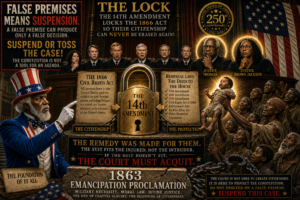 The central constitutional tragedy of the modern birthright citizenship debate is this:
That is the false premise.
The Civil Rights Act of 1866 came first. Congress declared that “all persons born in the United States and not subject to any foreign power, excluding Indians not taxed,” were citizens of the United States.
This was not an immigration statute. It was a Reconstruction remedy. It was remedial federal law written specifically for the formerly enslaved people and their children after centuries of chattel slavery, national degradation, forced illiteracy, and the Supreme Court disaster of Dred Scott.
Then came the 14th Amendment.
The 14th Amendment followed, not to create an unrelated immigration doctrine, but to LOCK the 1866 Act into the Constitution so that no future Congress, hostile court, or changing political majority could strip those people and their children of citizenship again, as is being attempted in this case.
That LOCK is the key to understanding the entire matter.
There was no separate “14th Amendment Birthright Citizenship” floating free from the 1866 Act.
The Amendment was attached to the Act’s remedial purpose.
It constitutionalized and secured what Congress had already established concerning the freedmen and their children.
But over time, a constitutional slide-drift emerged.
Courts and advocates increasingly detached the words “all persons born” from the historical injury being remedied.
The LOCK was slowly separated from the door it was designed to secure.
Eventually, later interpretations began treating the Amendment as a universal immigration mechanism rather than a Reconstruction-era protection clause.
That drift created the modern false premise.
Under that false premise, “anchorism” attempts to break open the LOCK itself in order to gain access to the latent constitutional powers, protections, and status flowing from the 1866 Act and the Reconstruction Amendments — powers which President Andrew Johnson so deeply feared in his veto message.
But the very structure reveals the error.
If the suit does not fit, the Court must acquit.
The Reconstruction citizenship suit was tailor-made for a specific historical injury. The fabric of that suit includes:
- chattel slavery,
- military liberation,
- Black Codes,
- denial of civil existence,
- forced illiteracy,
- exclusion from citizenship,
- and the urgent need to preserve the post-Civil War Union.
That suit fits the freedmen and their children because it was made for them.
But once the LOCK is broken away from its historical purpose and applied to unlawful foreign entry, the wearer immediately discovers that the rest of the constitutional garment does not fit.
The anchor claimant may attempt to seize one clause — “born” — while ignoring the remaining constitutional structure surrounding it:
- jurisdiction,
- allegiance,
- remedial purpose,
- Reconstruction history,
- federal protection obligations,
- and the identity of the people for whom the remedy was enacted.
Once the claimant proceeds beyond the opening words and walks through the broader architecture of Section 1 and the remaining Reconstruction framework, the mismatch becomes visible.
Essentially, intellectually speaking, such is a trap door into ultimate disaster, because what is beyond the door is poisonous to anyone who dares to cross into it.
Hence, the LOCK is actually a protective curse upon all persons born, but not qualified to risk catastrophe if they should break through, even in their minds, i.e., policy.
The historical descriptions in Johnson’s veto message do not apply to modern illegal entrants.
The occupational, racial, historical, and political conditions being remedied do not describe them.
The federal injuries being repaired were not inflicted upon them by the United States.
The constitutional medicine was not compounded for their ailment.
Thus, the modern doctrine increasingly rests on a false premise layered on earlier false premises.
And this is precisely why the Court should not proceed casually, as though this were merely another ordinary immigration dispute.
The issue is more fundamental.
The Court is now being asked to continue extending interpretations built on constitutional drift away from the original Reconstruction purpose — a drift that has accumulated over generations of assumptions detached from the remedial foundation of the 1866 Act itself.
Because if the underlying premise itself is historically and constitutionally defective, then continuing to build new doctrine upon it risks deepening the constitutional error rather than curing it.
Likewise, this concern extends beyond the Court to policy proposals themselves.
If a president attempts to apply sweeping future-only bans or immigration restrictions without resolving the underlying constitutional confusion concerning the Reconstruction foundation, the nation risks producing remedies that may create additional disorder rather than restoring constitutional balance.
The deeper question is therefore not simply: “Who was born here?”
The deeper constitutional question is:
“For whom was this Reconstruction LOCK originally forged — and what historical injury was it designed to prevent from ever happening again?”