MORATORIUM ON TRUMP v. BARBARA: Narrative (The Street)
Before the Court Decides: Let the Chattel Children Know What Is Theirs
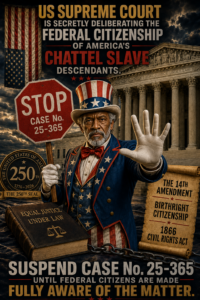 The Supreme Court docket identifies Trump v. Barbara as No. 25-365, involving President Trump’s challenge around birthright citizenship under the Fourteenth Amendment. Oyez summarizes the issue as whether Executive Order 14160 may deny citizenship recognition to certain U.S.-born children based on the immigration or temporary status of their parents.
Moratorium on Trump v. Barbara: Until the Chattel Children Are Heard
Before the Supreme Court decides Trump v. Barbara, there should be a moral and constitutional moratorium — not because immigration is unimportant, but because the nation is in danger of deciding a birthright-citizenship case without first informing the people whose ancestors made birthright citizenship constitutionally necessary.
This case is being argued publicly as a Trump case, an immigration case, a Barbara case, a children-of-noncitizens case, and a presidential-power case. All of those interests matter. But beneath them lies the deeper original matter: the Civil Rights Act of 1866 and the Fourteenth Amendment arose out of chattel slavery, emancipation, forced illiteracy, denied personhood, and the need to secure the citizenship of the formerly enslaved and their children.
That is why this moment cannot be treated merely as a modern immigration dispute.
If the Court rules for Barbara, birthright citizenship may be preserved in its broad modern form. But the chattel children may still lose if the decision celebrates citizenship generally while leaving them unnamed, uninformed, and invisible as the original remedial people for whom this constitutional protection was first required.
If the Court rules for Trump, the chattel children may lose in another way. A narrowed interpretation of birthright citizenship could disturb the very constitutional language that secured their ancestors’ national existence, especially if the Court fails to clearly distinguish their Reconstruction inheritance from present-day immigration controversy.
Either way, Trump may win or lose. Barbara may win or lose. Immigrant families may gain security or face uncertainty. The federal government may be empowered or restrained. But the chattel children may still lose if the case is decided over their heads, without their informed participation, and without the nation acknowledging that this constitutional question first arose because America had once treated their ancestors as property instead of people.
Therefore, the call for a moratorium is not anti-immigrant. It is not anti-Trump. It is not anti-Barbara. It is not delay for delay’s sake.
It is a demand for constitutional order.
It is a demand that before America decides who else is born into citizenship, America must first remember who had to be restored, secured, and constitutionally reborn into citizenship.
The Court may have the legal power to decide. But the nation has a moral duty to understand.
And the chattel children have a sacred and constitutional right to know what is theirs before others finish arguing over it.