The Case of Trump v. Barbara: Why a Moratorium Is Necessary Until Federal Citizens Are Sufficiently Informed
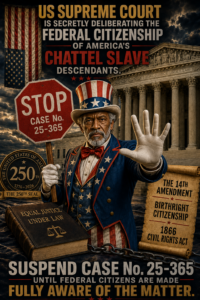 A Statement Calling for a Pause in National Immigration Debate Until the Original Federal Citizens Understand What Is at Stake
The case now before the Supreme Court, Donald J. Trump, President of the United States, et al. v. Barbara, et al., No. 25-365, concerns President Trump’s Executive Order No. 14160 and the meaning of birthright citizenship under the Citizenship Clause of the Fourteenth Amendment. The Supreme Court docket identifies the case as Trump v. Barbara, docketed September 29, 2025, arising from the First Circuit. Oyez summarizes the issue as whether the federal government may refuse to recognize citizenship for certain children born in the United States after February 20, 2025, depending on their parents’ legal status.
However, before this nation continues arguing over the immigration consequences of the case, there must be a serious moral, constitutional, and civic moratorium on the public discussion. Not because the immigration question is unimportant, but because the people most directly tied to the original remedial purpose of the Fourteenth Amendment — the American federal citizens whose existence, freedom, and constitutional identity were secured through the Civil Rights Act of 1866 and then locked into the Constitution by the Fourteenth Amendment — have not yet been sufficiently informed of what this case may mean for them.
Regardless of Who Wins, Federal Citizens Risk Losing
If the Supreme Court rules in favor of Barbara, the prevailing public story will likely be that birthright citizenship belongs equally and broadly to all persons born on American soil, including the U.S.-born children of noncitizen parents. That result may preserve the modern general understanding of birthright citizenship. Yet federal citizens may still lose if the ruling again treats the Fourteenth Amendment only as a universal immigration instrument while ignoring or burying its original remedial purpose: to secure the constitutional existence, citizenship, protection, and national standing of the formerly enslaved and their children.
In that outcome, the nation may celebrate the survival of “birthright citizenship,” while federal citizens remain largely uninformed about the specific Reconstruction inheritance embedded in that same clause. The baby of the foreigner may be publicly centered, while the baby of the freedman — the one for whom the remedial citizenship structure was first constitutionally demanded — remains historically hidden, civically unawakened, and politically unused.
If the Supreme Court rules in favor of President Trump, federal citizens may also lose, but in a different and perhaps more dangerous way. A ruling that narrows or reinterprets birthright citizenship could alter the national understanding of the Citizenship Clause itself. Even if the Court intends only to address children of certain noncitizen parents, the deeper danger is that the original federal citizenship inheritance of the freed people could again be folded into a generalized immigration fight, rather than being separately identified, protected, and restored to its rightful constitutional meaning.
In that outcome, the immigration controversy could become the tool by which the nation tampers with the very constitutional provision that was born out of chattel slavery, civil war, emancipation, and Reconstruction. The American federal citizen could once again become invisible inside a debate that was triggered by others, argued by others, interpreted by others, and decided by others.
The Problem Is Not Merely the Ruling — It Is the Framing
The greatest danger is not only whether Trump wins or Barbara wins. The greater danger is that the case is framed almost entirely as an immigration case, while the original federal citizens are left uninformed, unorganized, and unaware that the very constitutional language being debated is the language of their national rebirth.
This is why a moratorium is necessary.
The Court, Congress, the President, the media, legal scholars, immigration advocates, and the public should pause long enough to allow the federal citizens of the United States to become sufficiently informed about the Civil Rights Act of 1866, the Reconstruction Amendments, the original meaning of national citizenship, and the remedial purpose of the Fourteenth Amendment. Until that happens, the country is in danger of deciding the fate of a constitutional inheritance without the heirs fully knowing that the inheritance belongs to them.
Not Anti-Immigrant, Not Anti-Trump, Not Anti-Barbara
This call is not against immigrants. It is not against President Trump. It is not against Barbara. It is not against children born in America.
Rather, it is a call for order, truth, and constitutional clarity.
Before the nation decides whether the child of the foreigner receives citizenship by birth, it must first understand why the child of the freedman was constitutionally secured in citizenship by birth. Before America expands, limits, or redefines the Citizenship Clause in the heat of modern immigration politics, it must first acknowledge the people whose bondage, blood, forced illiteracy, exclusion, and denied personhood made that clause necessary in the first place.
A Necessary Pause for Constitutional Education
Therefore, we call for a moratorium on immigration-centered public argument around Trump v. Barbara until federal citizens are sufficiently informed of the matter that pertains to their existence in the United States.
The public must be educated.
The federal citizens must be awakened.
The original remedial purpose must be examined.
The Civil Rights Act of 1866 must be brought forward.
The Fourteenth Amendment must be understood not merely as an immigration provision, but as a constitutional remedy born out of slavery, emancipation, and the necessity of securing a people who had been treated as property and then restored as citizens.
Until that is done, any ruling — whether for Trump or for Barbara — risks becoming another national decision made over the heads of the very people whose constitutional identity stands at the foundation of the matter.
Closing Declaration
This is not the time for federal citizens to remain silent while others debate the instrument of their constitutional existence.
This is the time for informed pause.
This is the time for civic awakening.
This is the time to say that before America decides who else is born into citizenship, America must finally understand who was first restored, secured, and constitutionally reborn into federal citizenship.
For if the Court rules for Barbara without naming us, we lose by invisibility.
If the Court rules for Trump without protecting us, we lose by vulnerability.
And if the nation continues the debate without educating us, we lose by ignorance.
That is why a moratorium is necessary.